

I have stated before now that everywhere we have travelled we have, almost invariably, been met with politeness and good humour. Some greetings have become familiar to us, and yet – speaking for myself – escape reciprocation, verbally, to this point. For clarity, I do actually respond but in my own language. So, as is my wont, I am consulting the World Wide Web (its uses far outweigh its ills?) using my Steve Jobs inspired tool (see yesterday’s post).
In Thailand, one is greeted most graciously, commonly with the person greeting you having their hands together and offering a bow of the head.
This short video is useful, if a little monotone in delivery. The Thai language is certainly not monotone.
N.B. You may need to download the YouTube app to your device to run smoothly into the embedded videos on this and other blog posts.
In Thai, every syllable is pronounced in one of five tones: low, mid, high, falling, or rising. The tone must be spoken correctly for the intended meaning of a word to be understood.
And so, simply saying ‘hello’ or ‘good bye’ is given more meaning by being said in this way…
I mentioned the bow of greeting with hands together. This short video – if delivered in a light-hearted manner – brings it all together. Leaving me cross with myself for not seeking understanding earlier than this.
Interesting that there is a subtle distinction in form of bow for parents, teachers, and the elderly. In a shop, yesterday, the young lady who served me finished with – in English – “Thank you, Papa. Have a good day.” It tickled my wife, who confirmed for me that this is exactly what she did say. I thought on it as I walked away and concluded: how lovely, I am absolutely ok with that!
The Thai language (also referred to historically as Siamese) belongs to the Tai language family. This family of languages is a part of the broader Kra-Dai language family, which includes other languages spoken in Southeast Asia. The Thai language was thought to have originated from the region that is today the border between Vietnam and China.
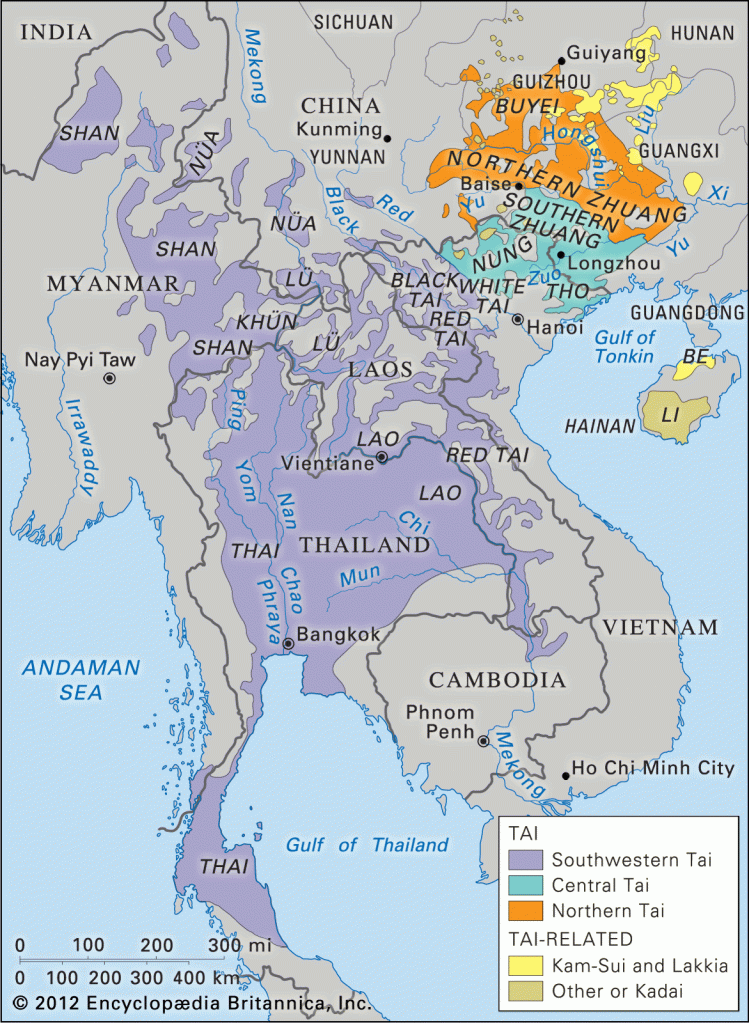
Alas, the longer you live, the more you have it confirmed for you that, nothing is ever simple. Here is where it gets a little less straightforward…
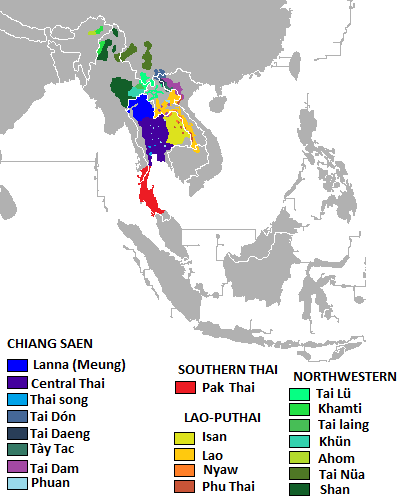
The largest native language is Southern Thai (Thai: ภาษาไทยใต้ [pʰaːsǎː tʰajtâːj]), also known as Pak Thai or Dambro (Thai: ภาษาตามโพร [pʰaːsǎː taːmpʰroː]).
So, now we get to it, it is Pak Thai that is spoken in Phuket. But wait, apparently, Pak Thai is spoken the fastest, and locals shorten words to single syllables and sentences to a few words.
I’m out! I will simply do my best. And if my best is returning greeting with greeting, enacting a polite bow, so be it. I have to say that we both took to returning a bow of greeting with a bow, very early on. It was a very strong feature of the Cambodian people’s manner; not so the Vietnamese.
To conclude, I have commented previously on my love of ornate and intricate script, ancient languages, in particular. The writing system for the Thai language emerged in 1283 under King Ramamhaeng’s reign, known as the Thai script (อักษรไทย). It was derived from the Khmer script, which originated from the Pallava alphabet used in Southern India. Although the Thai script is informally known as the Thai alphabet, the script is not an alphabet – it is an abugida or “pseudo-alphabet.”
This made me wonder on Arabic and my postponed attempt to learn it. Arabic – that is, its writing system rather than the language itself – is not an abugida but an abjad; that is, its alphabet consists entirely of consonants which may be augmented by markings that indicate the vowel sounds that are used in speech, but are not necessary for writing.
There! I have picked up my new word(s) for the day, abiguda, and abjad.
In summary:
Hello (male polite form)
Sa-wad-dee-krab
(สวัสดีครับ)
Hello (female polite form)
Sa-wad-dee-ka
(สวัสดีค่ะ.)
Not quite so straightforward is it, Lionel? Now quit that dancing on the ceiling malarkey, read my blog and give it some attention!

Return to homepage

 A Dragon Apparent
Leave a comment